Review Sheet Exercise 5 Classification of Tissues Answer Key
NCERT Solutions Grade 9 Scientific discipline Chapter half-dozen – CBSE Term I Complimentary PDF Download
NCERT Solutions for Class nine Science Chapter half dozen – Tissues is the best study material through which students tin can refer and ready their notes for their CBSE Term I test. These NCERT Solutions are available in chapter wise and students can also discover answers to all the questions bachelor in their Class 9 Science NCERT textbooks. Here, in this written report material, students tin find detailed explanations for all the topics and are explained in a simple linguistic communication, along with the examples, diagrams, flowchart in a more accessible format.
NCERT Solutions for Class 9 Scientific discipline Affiliate 6 – Tissues is one of the about of import topics in the CBSE Term I exam. The faculty have curated the solutions in a lucid way to help understand the concepts amid the students. For a more clear idea about the chapter students can refer to the study materials available at BYJU'Southward.
Download PDF of NCERT Solutions for Class nine Science Chapter 6: Tissues
Access Answers to NCERT Class nine Science Chapter half dozen: Tissues (All in text and Practise
Questions solved)
Exercise-6.1 Page: 69
ane. What is a tissue?
Solution:
A tissue is divers as a cluster of cells which are similar in structure and work together to perform a particular role.
ii. What is the utility of tissues in multicellular organisms?
Solution:
The use of tissues in multicellular organisms is to provide structural and mechanical force likewise equally to allow division of labour.
Exercise-6.2 Page: 73
three. Name types of simple tissues.
Solution:
The types of simple tissues are as follows:
➢ Parenchyma
➢ Collenchyma
➢ Sclerenchyma
4. Where is apical meristem found?
Solution:
In plants, apical meristem are typically plant at:
- The tip of the shoot
- Root of the institute
five. Which tissue makes up the husk of coconut?
Solution:
The Sclerenchymatous tissue, which is a blazon of permanent tissue makes upward the husk of the coconut. These tissues causes the institute to get stiff and hard. The cells of this tissue are dead and their cell walls are thickened because of the presence of lignin.
6. What are the constituents of phloem?
Solution:
The phloem constitutes of the following four elements, they are:
➢ Sieve tube
➢ Companion cells
➢ Phloem parenchyma
➢ Phloem fibres
Exercise-vi.3 Page: 77
vii. Name the tissue responsible for motility of our body.
Solution:
Two tissues jointly are responsible for the motion of our torso, namely:
➢ Muscular tissue
➢ Nervous tissue
8. What does a neuron look like?
Solution:
A neuron is a nerve prison cell consisting of the cell body with a nucleus and cytoplasm from which a long and sparse hair like structure emerges. Every neuron has 1 elongated function known as the axon, and several brusk and modest branched structures known equally dendrites. A single neuron can even be a meter long.

9. Requite three features of cardiac muscles.
Solution:
The cardiac muscles are specialized tissues that are evolved to pump blood throughout the body.
The following are the features of the cardiac muscles:
➢ They are cylindrical in shape.
➢ Striated muscle fibers.
➢ They are uninucleated and branched.
➢ These muscles are involuntary in nature.
10. What are the functions of areolar tissue?
Solution:
Areolar tissues are typically observed in animals. They are connective tissues and are establish in between skin and muscles. They are likewise located effectually blood vessels and nerves and are present in the os marrow. The space inside the organs is filled with these tissues. They back up the fragile internal organs and assistance in tissue repair in case of damage.
Exercise Folio: 78
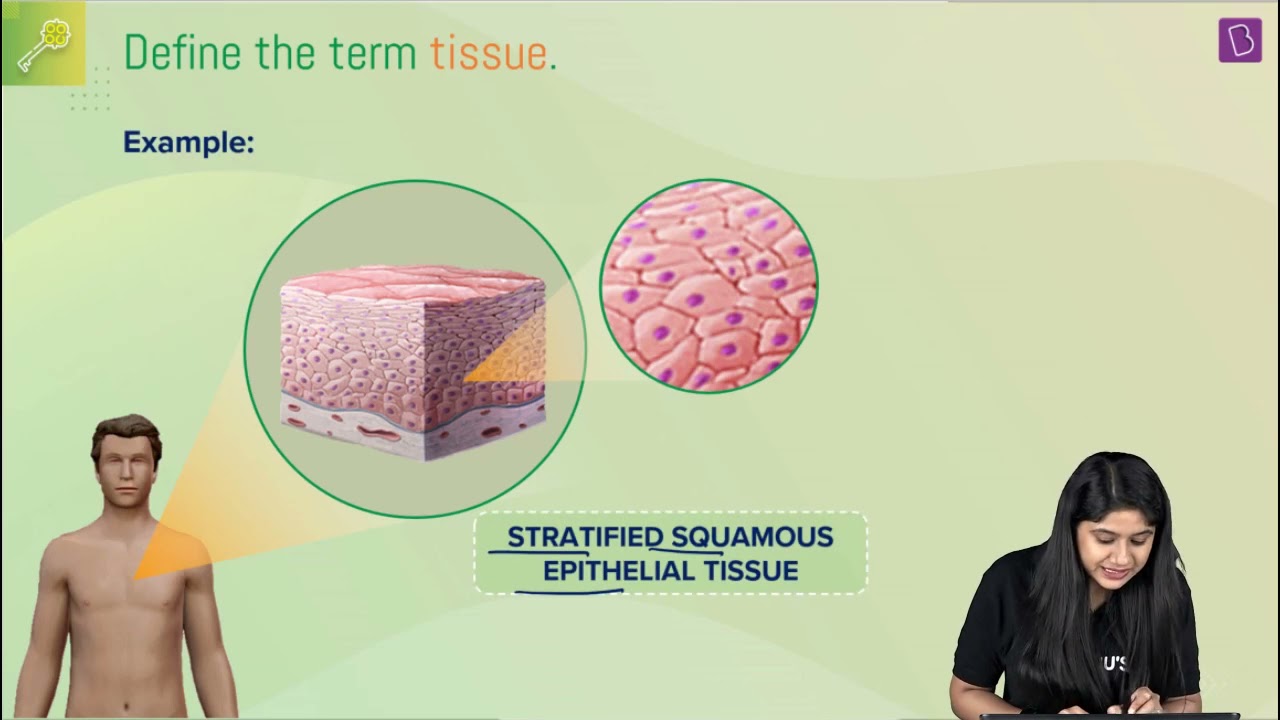
1. Define the term 'tissue'?
Solution:
A tissue is defined as a cluster of cells which are similar in structure and work together to perform a particular function.
2. How many types of elements together make up the xylem tissue? Name them.
Solution:
The xylem tissue is made up of 4 main elements, namely:
➢ Vessels
➢ Tracheids
➢ Xylem fibres
➢ Xylem parenchyma
3. How are elementary tissues dissimilar from complex tissues in plants?
Solution:
The post-obit are the differences:
| Uncomplicated tissues | Complex tissues |
| They are made upwardly of a single type of cell that performs only one common role | They are fabricated upwardly of more than i kind of a cell that coordinate to perform 1 detail function |
4. Differentiate betwixt parenchyma, collenchyma and sclerenchyma on the footing of their cell wall.
Solution:
The following are the differences based on prison cell wall between unlike tissues:
| Parenchyma | Collenchyma | Sclerenchyma |
| Prison cell walls are thin and made upwardly of cellulose | Cell walls are thick at the edges due to the deposition of pectin | Cell walls are thick due to the deposition of lignin |

v. What are the functions of the stomata?
Solution:
Stomata are the tiny pores present on the outer layer of the cells, the epidermis. Stomata bring nigh the substitution of gases and transpiration.
6. Diagrammatically show the difference between the 3 types of muscle fibres.
Solution:
There are three types of muscle fibres, they are:
1. Cardiac muscles
- Present in the heart.
- Involuntary in nature.
- They accept 1 nucleus.
- The muscle fibers are branched.

2. Smooth muscles
- Constitute in lungs and gastrointestinal tract.
- Involuntary in nature.
- They take ane nucleus.
- They are spindle shaped.

3. Striated muscles
- They are connected with bones
- Voluntary in nature.
- They are long and cylindrical muscle fibers.
- They possess many nuclei.
- Striated muscles are unbranched.

seven. What is the specific function of the cardiac muscle?
Solution:
The cardiac muscles are branched and cylindrical. They are uninucleated and are involuntary in nature. Throughout one'southward lifetime, the cardiac muscles bring almost the rhythmic contraction and relaxation.
8. Differentiate between striated, un-striated and cardiac muscles on the footing of their structure and site/location in the body.
Solution:
The following are the differences betwixt different types of muscles based on their structure and location in the body.
| Character | Striated muscles | Un-striated muscles | Cardiac muscles |
| Shape/Construction | Long, cylindrical, not – tapering. They are united nations-branched. | Long and tapering. They are un – branched. | Cylindrical and not – tapering. They are branched. |
| Location in torso | Hands, legs and skeletal muscles | Wall of stomach, intestine, ureter and bronchi | Centre |
| Dark and light bands | Present | Absent-minded | Present but less prominent |
9. Draw a labelled diagram of a neuron.
Solution:
Diagram of a neuron forth with the labelling is as follows:

10. Name the following.
(a) Tissue that forms the inner lining of our mouth.
(b) Tissue that connects muscle to os in humans.
(c) Tissue that transports food in plants.
(d) Tissue that stores fat in our body.
(e) Connective tissue with a fluid matrix.
(f) Tissue present in the encephalon.
Solution:
(a) Tissue that forms the inner lining of our oral fissure – The epithelial tissue, Squamous epithelium.
(b) Tissue that connects muscle to bone in humans – Tendon
(c) Tissue that transports food in plants – Phloem
(d) Tissue that stores fat in our trunk – Adipose tissue
(e) Connective tissue with a fluid matrix – Blood, it is a fluid connective tissue
(f) Tissue present in the encephalon – Nervous tissue
11. Identify the type of tissue in the following:
Skin, bark of tree, bone, lining of kidney tubule, vascular packet.
Solution:
➢ Skin: Striated squamous epithelial tissue
➢ Bark of tree: Protective tissue and cork
➢ Bone: Connective tissue
➢ Lining of kidney tubule: Cuboidal epithelial tissue
➢ Vascular package: Conducting tissue(xylem and phloem). Complex permanent tissue
12. Name the regions in which parenchyma tissue is nowadays.
Solution:
The parenchyma is found in:
- The pith of stems and roots
- When parenchyma contains chlorophyll information technology is called equally chlorenchyma, it is institute in light-green leaves
- Parenchyma found in aquatic plants has large air cavities which enables them to float and are hence called aerenchyma.
13. What is the role of epidermis in plants?
Solution:
The epidermis in plants forms an uninterrupted and continuous layer that has no intercellular spaces. It provides protection.
14. How does the cork act as a protective tissue?
Solution:
Cork cells are expressionless. The organization of cells is and then dense, that there is no intercellular space. Deposition of suberin is observed on the walls of the cells that make them impervious to h2o and gases.
15. Consummate the post-obit chart.

Solution:
The completed chart is as follows:

NCERT Solutions for Class nine Scientific discipline Chapter 6: Tissues
NCERT Solutions for Class 9 Science Chapter 6: Tissues is i of the well-nigh important topics with high weightage in the exam and the expected marks as per the exam pattern is 20. Most of the questions have been repeatedly asked in both CBSE Term I and other competitive exams. Students can refer to these written report materials and score good marks in their Term I CBSE examination. These NCERT Solutions for Class nine Scientific discipline are prepared by a team of our subject experts to aid students of Class ix in their preparations and to have a good foundation on the subject area.
6.1 Are Plants and Animals Made of Same Type of Tissues? 2 Questions (1 long)
6.2 Found Tissues 4 Questions (ii short , 2 long)
6.two.1 Meristematic Tissue ii Questions (ii MCQ)
6.ii.two Permanent Tissue 1 Question (1 MCQ)
half dozen.3 AnimalTissues 4 Questions (1 short , iii long)
6.three.ane Epithelial Tissue 1 Question (1 short )
6.3.ii Connective Tissue one Question (ane brusque )
six.iii.3 Muscular Tissue ane Question (1 short )
6.3.four Nervous Tissue 1 Question (1 curt )
Form 9, Scientific discipline Affiliate vi: Tissue is an extremely interesting topic which provides the complete information related to tissue, types of tissue, and their functions. This topic provides a bones framework for the next level, including the beefcake and physiology of the human trunk. Other interesting topics explained in this chapter include, types of tissues in multicellular organisms, their structure, location and their functions. Forth with this topic, students can besides find some interesting activities or experiments on tissues.
Key Features of NCERT Solutions for Class 9 Science Chapter half dozen: Tissues
- NCERT Solutions are the best study textile for those students having trouble in finding the answers to different questions related to the respective topics.
- Along with the textbook solutions, students can also find some important questions, keynotes and other data about the topic.
- These NCERT Solutions are prepared by a team of expert teachers and it covers all the fundamental concepts of the chapter and other important questions from the term exam indicate of view.
- The solutions explained in these study materials are well arranged in a systematic manner to permit comprehensive learning with a improve agreement for all the students.
- NCERT Solutions for Grade ix Scientific discipline Affiliate half dozen, Tissues provides complete information regarding the topic along with the definitions and examples which are explained in a uncomplicated language and in a more accessible format for students to learn better and effectively.
Frequently Asked Questions on NCERT Solutions for Form 9 Science Chapter six
Why is the BYJU'S NCERT Solutions for Class ix Science Chapter vi important?
At BYJU'S, the expert faculty frame the NCERT Solutions based on the agreement abilities of Class 9 students. Descriptive answers for each question in a uncomplicated language boost the conceptual agreement amidst students. Both chapter wise and exercise wise solutions are available which tin be referred by the students while answering the questions from the NCERT textbook. Fifty-fifty the PDF format of solutions are present which can be downloaded and used by the students every bit per their necessity.
What concepts will I larn from the NCERT Solutions for Class 9 Science Chapter 6?
From the NCERT Solutions for Class 9 Science Affiliate vi, you will larn near the concepts like –
half-dozen.1 Are Plants and Animals Made of the Same Blazon of Tissues?
6.two Plant Tissues
6.ii.1 Meristematic Tissue
6.2.2 Permanent Tissue
6.3 Animal Tissues
6.3.1 Epithelial Tissue
6.3.2 Connective Tissue
half-dozen.3.iii Muscular Tissue
6.3.iv Nervous Tissue
What are the advantages of using the NCERT Solutions for Class 9 Science Affiliate vi from BYJU'S?
1. Students facing difficulty in finding answers of respective topics can refer to the NCERT Solutions from BYJU'S.
2. The important questions, shortcut techniques and other information can exist obtained easily by the students.
3. The skilful kinesthesia design the solutions which cover all the fundamental concepts and questions which are important for the CBSE Term I examination.
4. These solutions are bundled in a systematic manner which develops comprehensive learning amidst students.
5. The important definitions and examples are explained in an interactive manner to make learning fun for the students.
robersonhilen1988.blogspot.com
Source: https://byjus.com/ncert-solutions-class-9-science/chapter-6-tissues/
0 Response to "Review Sheet Exercise 5 Classification of Tissues Answer Key"
Postar um comentário