Old English House With Windows Boarded Up Baby in Incubator
Notes:
This lesson covers the main rooms of a firm as well every bit vocab for some common household objects.
Lesson Procedure:
Warm Up and Maintenance:
Run across our "Warm Upward & Wrap Up" page.
New Learning and Practise:
1. Teach rooms vocab
Earlier grade, cut out 6 pictures of household objects from a magazine/itemize: one for each of the rooms of a house, for case:
bed (for the bedroom), refrigerator (for the kitchen), shower (for the bathroom), TV (for the living room), dining table (for the dining room), flowers (for the garden).
On the board depict a picture of a house, similar to below. Make sure y'all draw information technology as big as possible to fill the board.
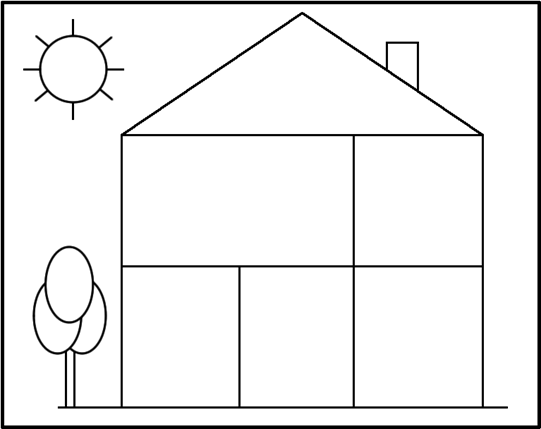
Arm-twist the words house, tree and dominicus. Y'all can also teach/elicit "roof" and "chimney" as extra vocab.
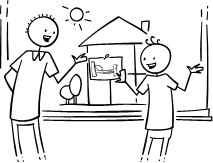 Next, hold up the cut out "bed" magazine picture show and arm-twist/teach the word. Ask one student to come up to the lath stick the picture in ane of the rooms (make sure it is the large, upstairs room). Practise the same with the other 5 pictures, each time eliciting the give-and-take and getting a student to stick on your house and so that each room has a picture in it (and one outside in the garden).
Now, elicit/teach the words for rooms of the business firm and garden: betoken at the bedroom and ask "What room is this?". If no i knows, say, "Well, it has a bed and it is a room, and so it'southward a ..." and effort and elicit "chamber". And so write the word in the room and chorus iii times.
Practise a similar affair with the other places, e.1000.
- bathroom: a room with a bath
- living room: a room where we live
- dining room: a room where we swallow dinner (dinner room ... dining room)
- kitchen/garden: not compound words so can't teach this manner - just teach and chorus.
2. Play the "Rooms of a house Quiz"
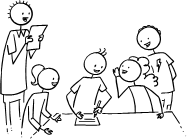 Put your students into groups (of two-half dozen students per grouping, depending on how many students are in your class). Get each group to elect a squad captain and and so requite each captain a piece of paper and pencil. Tell the captains to write the numbers one to 12 downward the left-side of the paper. Each captain is going to write the 12 answers to the quiz questions on this sheet, simply the residue of the group will help give him/her the answers.
The teacher reads out the following questions every bit the groups write the answers on their sheets:
one. Where in the business firm practise you brush your teeth? (bathroom)
2. Where in the house exercise you cook food? (kitchen)
3. Where in the business firm do you sleep at nighttime? (bedroom)
4. Where in the business firm do you consume dinner? (dining room)
5. Where in the house do you sit down with your family and lookout Television receiver? (living room)
six. Where do yous run across grass? (garden)
7. Where are your books, toys and games (bedchamber)
8. Where are the dishes washed? (kitchen)
nine. Where can you lot sunbathe? (garden)
10. Where does your family unit relax together? (living room)
11. Where can you get wet inside your house? (bathroom)
12. Where is the largest table? (dining room)
Finally, go through the answers with the class by pointing to the correct room on your board flick and helping out with whatever vocab that students don't sympathize. The winning group gets a round of adulation from everyone.
iii. Practice "Rooms of a house Posters"
Put your students into vi groups (for smaller classes, iii groups is fine). Give each group the post-obit:
- one large piece of card / construction paper
- a magazine/catalog with lots of photos of household objects (at least 1 per group)
- pair of scissors and glue
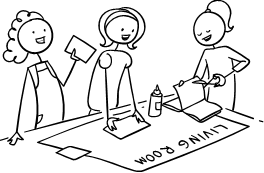 Assign each group a room of a house (or garden) and get the groups to write the room name at the top of their construction paper. So, for example, i group will brand a "sleeping accommodation" poster, another a "living room poster", etc. If your class is small-scale and you only have three groups, each group will accept two pieces of construction paper (therefore they will practise two room posters).
Tell everyone to look through their magazines/catalogs and cut out pictures to stick on their poster for their room. Demonstrate this with one room before you get-go to make certain everyone understands (e.k. in living room: a sofa, a TV, rug, coffee table, etc.).
Give students 5 minutes for this.
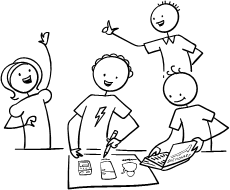 When each group has finished, tell everyone that they take to write the words for the things they have stuck on their posters. Having picture dictionaries or even use of a reckoner is ideal for students to observe the words. Some other alternative is a itemize in English. If you don't have whatever of these resources, you can assist students with the words they don't know. By the end, all of the pictures should be labeled correctly.
When all of the posters are complete, get each group to stick theirs to the walls of the classroom - try and get them evenly spaced effectually the room.
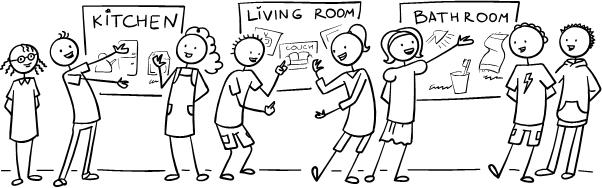
4. Play "Bear upon the moving picture"
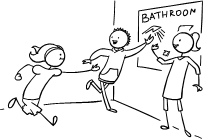 Get everyone to sit in the middle of the classroom. Beginning, the teacher goes to each affiche and choruses each picture 2 or 3 times (e.chiliad. "bed, bed, bed"). Do this quite quickly to avoid students getting bored. And so, tell everyone that y'all are going to say an object and everyone has to race to touch it on the poster. The first person to touch it is the winner. Shout out a give-and-take (e.g. "shower!") and anybody rushes to touch that picture. Then continue shouting out other words, as students race effectually the room touching objects on the posters. This should exist fast paced and fun.
5. Play "Bear upon the picture" in pairs
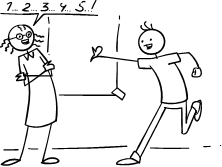 Now, pair upwardly students. Educatee A will say an object from any poster and Pupil B has to discover and touch it. Sounds easy? Well, give a time limit for the students to find and bear upon the picture (eastward.g. 5 seconds - depending on the levels of your students). For example:
Pupil A: Observe a lamp! i ... ii ... 3 ... four ... five ... Time's up!
Student B: (runs around searching for a lamp picture to affect)
6. Do the "Objects in my house" worksheet
Give out the worksheets. First, get students to write the words for each room on their worksheets. Then go the students to utilise the posters effectually the room to write words and draw pictures of the objects they have in their home.
 Notation: If students don't have certain rooms in their homes (due east.g. dining room, garden) have them put in objects they have in other rooms that could become in those rooms.
When everyone has finished, put students into pairs. Teach the phase:
Exercise yous have a/an (sofa)?
or
Take you got a/an (sofa)? (British English)
Then have pairs ask each other virtually what they have and don't take in their homes using their worksheets as a guide.
7. Read classroom reader "Mr. Stretch's House"
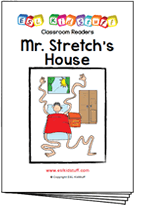 Let's end with a fun story that practices the vocabulary in today'south lesson. Before grade, download and print off the reader "Mr. Stretch'due south House". Equally y'all go through each page, point to the pictures and arm-twist the rooms, as well as other vocab for the objects in the rooms, for example:
Teacher: (pointing at the picture on page 4) What room is this?
Students: The kitchen!
Teacher: Aye, that's right! What is Mr. Stretch getting?
Students: A banana!
Teacher: Yes, good job! He's stretching his arm all the manner into the kitchen to become a banana! And where is he getting the banana from (pointing at the fridge)?
Students: A refrigerator!
Teacher: Yes, that's right! (Reading) "He is getting a banana from the fridge!". Exercise you accept a refrigerator in your kitchen, Kate?
Kate: Aye, I do!
Teacher: And do you lot have bananas in your refrigerator?
Kate: Um, no.
Teacher: Kate doesn't have bananas in her refrigerator. Does any here have bananas in their refrigerator?
David: Yes, I do!
Instructor: Ah, David does! What other food is in your refrigerator?
David: Um. Ham and eggs and milk.
Teacher: Very good, David! Ok, anybody, what else is in Mr. Stretch'due south kitchen?
Students: A cooker!
etc.
 Get the students actually involved in the story past asking lots of questions virtually the what objects they have in their homes.
After reading the story, give out a reader worksheet to each student and read through the story one more fourth dimension (without stopping for questions, etc.) every bit students match the objects in the story to the different rooms. Then become through the answers every bit a class.
---
Alternatively, watch our video version of the reader (Net connection required):
Wrap Up:
i. Assign Homework: "Home Plan" worksheet (be sure to model this start by drawing a programme of your home).
2. Wrap up the lesson with some ideas from our "Warm Up & Wrap Up" folio.
robersonhilen1988.blogspot.com
Source: https://www.eslkidstuff.com/lesson-plans/rooms-of-a-house.html
0 Response to "Old English House With Windows Boarded Up Baby in Incubator"
Postar um comentário